AI-Assisted Candidate Screening for K-12 Recruiters
Researching recruiter decision-making to inform AI-powered candidate evaluation.

TOOLS
User Interviews recruitment
Zoom sessions
Cursor prototype
Dovetail analysis
ROLE
UX Researcher
PARTICIPANTS
K-12 recruiters and HR leaders
METHOD
1:1 in-depth interview
I — PROBLEM
The challenge
In Winter 2025, PowerSchool was exploring AI applications in our Applicant Tracking System product.
Knowing that recruiters often review hundreds of applications for a single position, making candidate screening one of the most time-intensive parts of the hiring process, the team wanted to explore how AI could help recruiters identify strong candidates more efficiently. Before introducing AI into the workflow, my goal was to understand how recruiters actually evaluate applicants and what decision-making framework AI should emulate.
II — METHOD
How I approached it
I conducted 11 one-on-one interviews with K-12 recruiters to understand how they review applications, assess qualifications, and determine which candidates advance to first-round interviews.
I examined the criteria recruiters use, how they weigh candidate strengths, and their perceptions of AI involvement in hiring decisions.
The findings were synthesized into recommendations for a recruiter-informed evaluation framework that could guide the development of an AI screening experience.
III — KEY INSIGHTS
What I learned
01
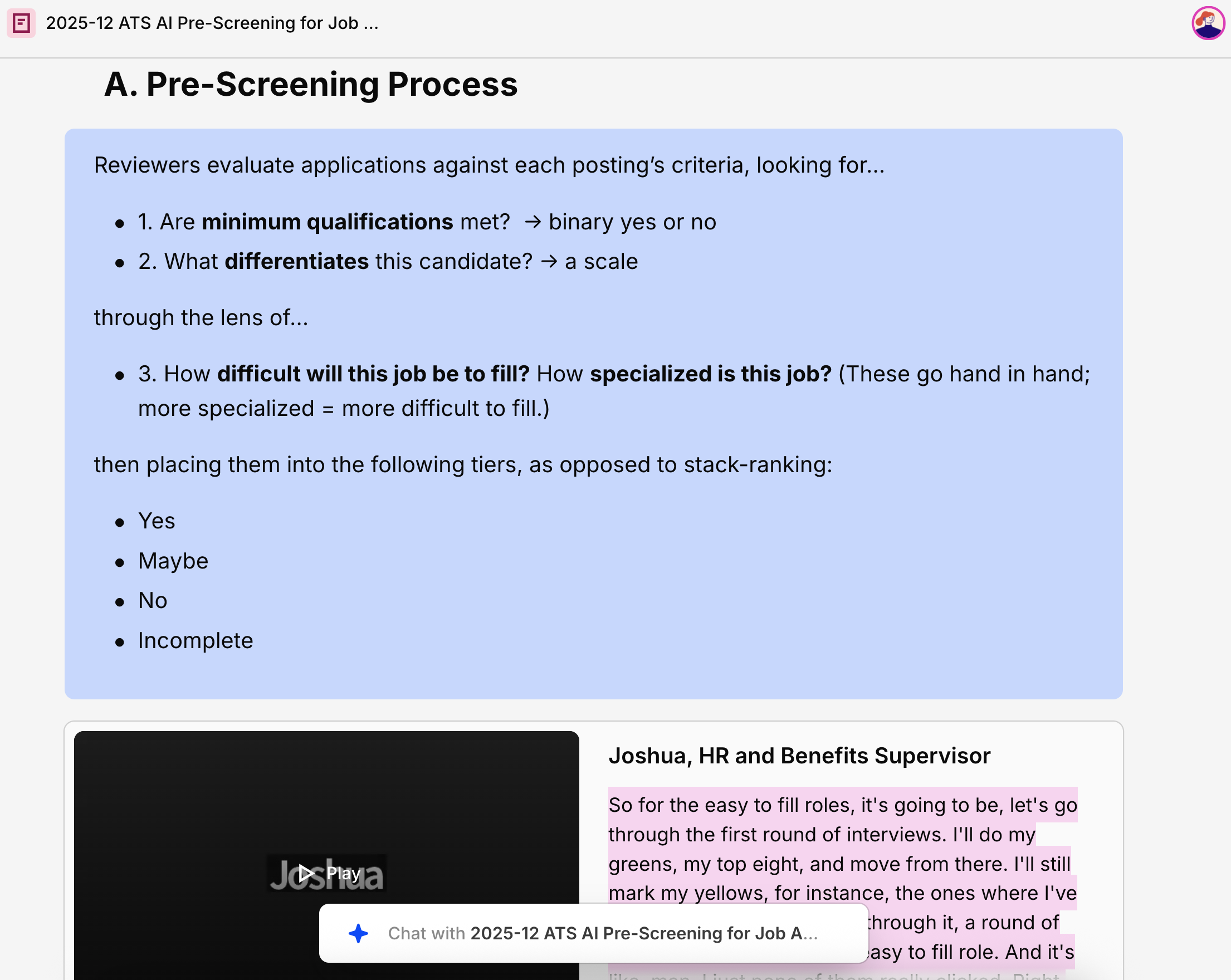
Recruiters categorize candidates rather than rank them.
Contrary to initial assumptions, recruiters do not evaluate applicants in a stack-ranked order. Instead, they sort candidates into decision categories such as Yes, Maybe, and No before selecting interview candidates.
02
Recruiters start with binary thinking for eligibility, then evaluate nuance on a scale.
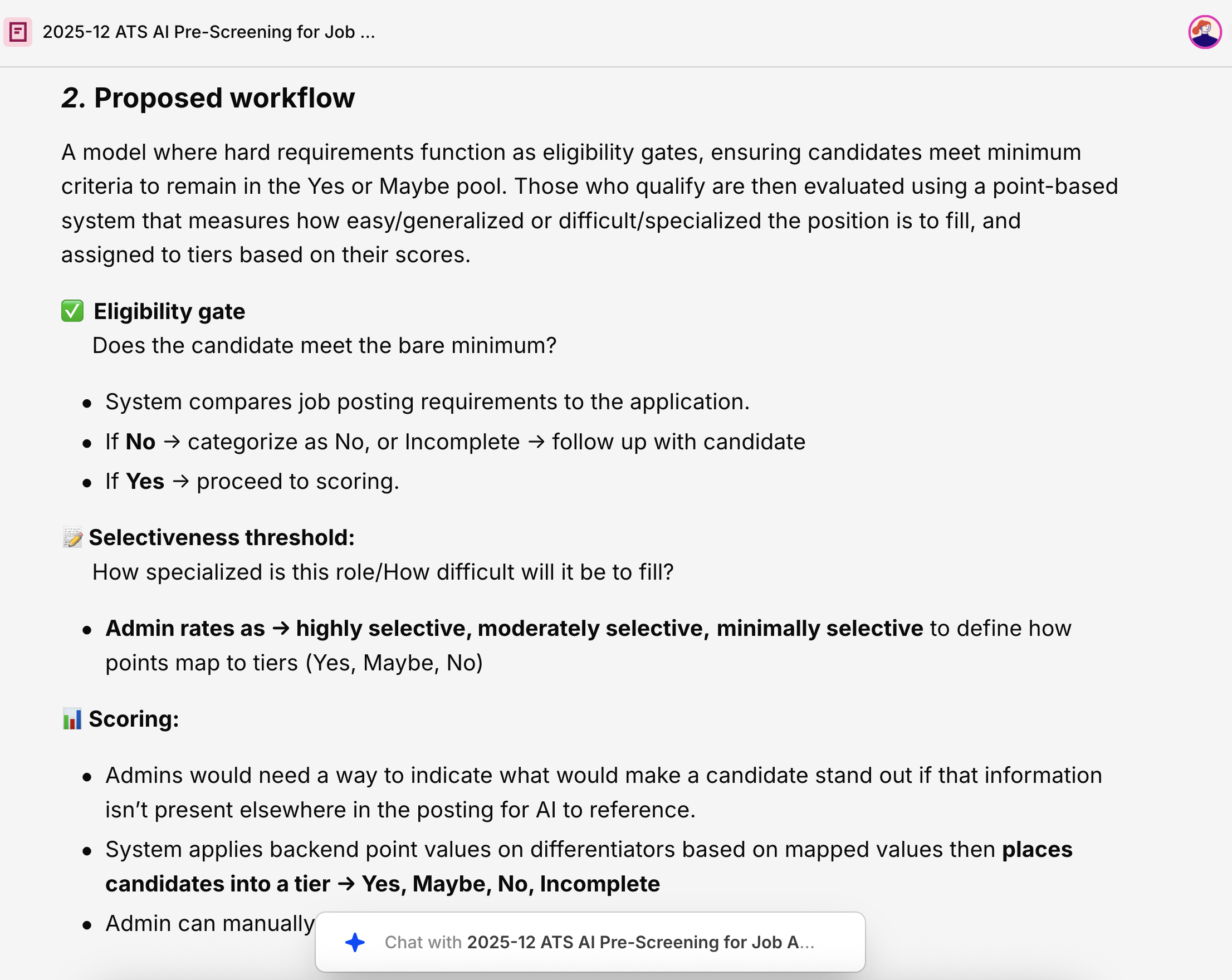
Recruiters first determine whether candidates meet minimum requirements, like licensure or minimum years of experience.
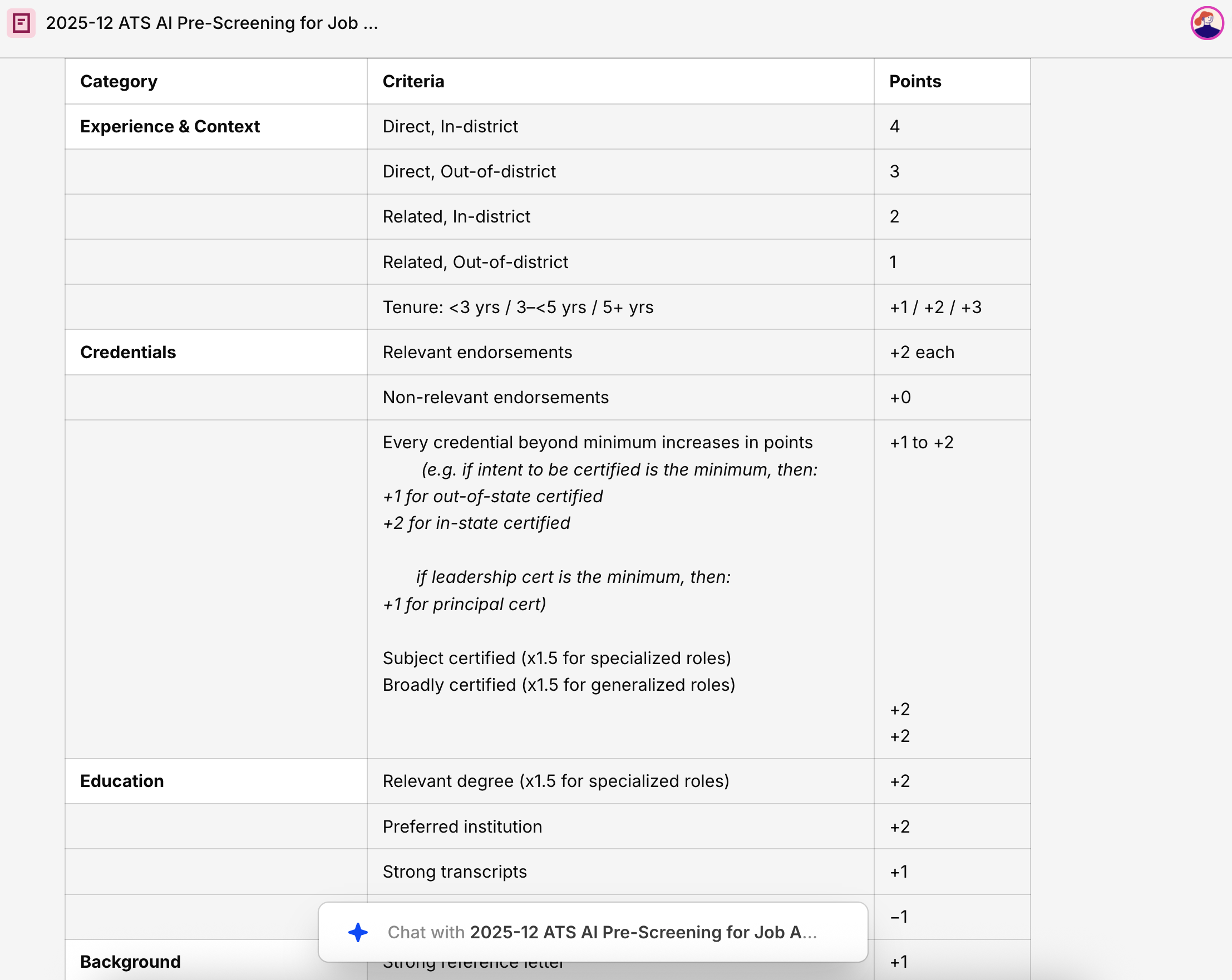
Once eligibility is established, they shift to a more nuanced assessment, weighing factors like endorsements or more years of experience to determine candidate strength.
03
Candidate strength is relative to hiring context.
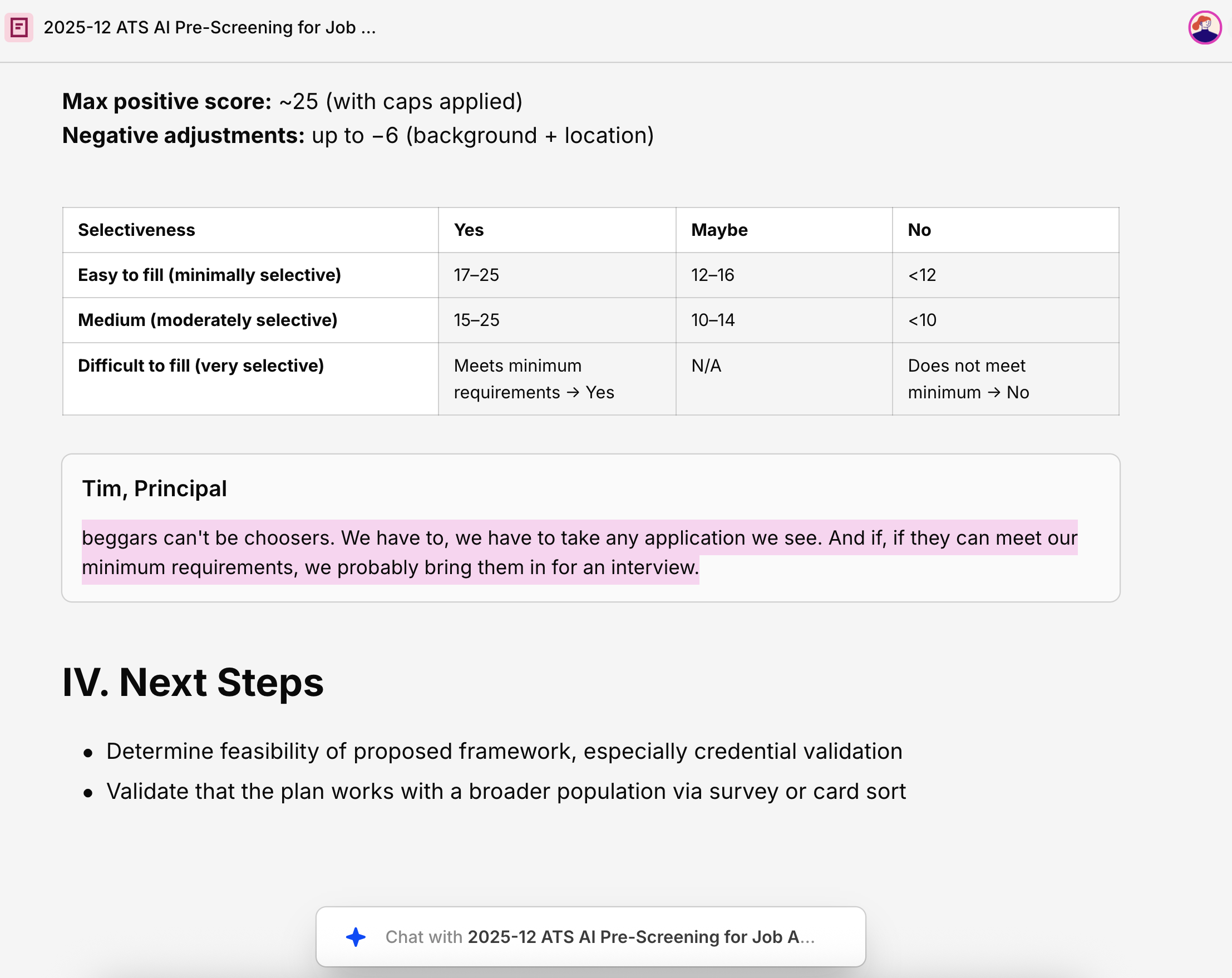
Recruiters evaluate candidates against the realities of their hiring environment, so their mental rubric adapts.
Expectations shift based on district characteristics (rural, urban, etc.), talent availability, and specialization of the role.
As a result, the same application may be evaluated differently across districts.
IV — ALIGNMENT
What I brought to the team
I transformed recruiter decision-making into a framework that could inform AI behavior.
Rather than delivering a list of findings alone, I synthesized recruiter mental models into a proposed evaluation framework that the product and engineering team could operationalize.
The framework served as a starting point for how AI could assess eligibility, evaluate candidate strength, account for hiring context, and categorize applicants in ways that aligned with real-world recruiting practices.
Selections from my report are included below.
What resulted from this research
Corrected a foundational product assumption.
Research revealed that recruiters categorize candidates rather than rank them, reshaping the team’s anticipated approach to presenting candidate evaluation.
01
Created a recruiter-informed framework for AI decision-making.
Findings were synthesized into a proposed evaluation model that reflected recruiter mental models, including eligibility gates, scaled qualification assessment, and candidate categorization logic.
02
Established the foundation for future AI validation.
The framework informed an internal proof of concept and created a baseline for evaluating AI-generated candidate assessments.